• Skip to main content
  • Skip to footer

Disrupt Land Forces

war crimes start in corporate boardrooms

  • Media
    • November 8 Media Statement
    • Community Letter on Land Forces Policing 
    • September 11 Media Statement
  • About Disrupt
    • First Peoples First
    • Our Commitment
    • The Collaboration
    • Why we disrupt
    • Five reasons to Disrupt Land Forces
    • West Papua Calling
    • Copping the bill
    • Disrupt Land Forces in the Media
  • Resources
    • Weapons Dealers in Australia: A Map
    • Deregister AMDA
    • Community Letter
    • Disrupt Posters
      • Disrupt Posters
      • WANTED POSTERS
      • TW: Weapons impacts.
    • Weapons Companies
      • Thales
        • Thales Factsheet
        • The Arms Dealer, The Activist and the Refugee
      • Boeing
      • Rheinmetall
      • EOS
      • Elbit
      • NIOA
      • Lockheed Martin
      • Hanwha
    • Background and research
    • Song & Chants
  • DLF stories
    • 2024 Disrupt Land Forces
      • DLF 24 part one: Organising
      • DLF 24 part two: Mobilising
      • DLF 24 part three: Resisting
      • DLF 24 part four: Enduring
    • 2022: War Criminals need not apply
    • Disrupt Land Forces 22 Gallery
    • 2021: Thanks but no tanks
    • 2021: Disrupt Land Forces was glorious
    • Disrupt Land Forces 21 Gallery

disrupt wars

Jan 13 2025

DLF 24 part one: Organising

Disrupt Land Forces protesters hold a banner stating 'Capitalism Kills No $$ For War, in front of a large crowd of protesters.

The process of reflection

This report is an assemblage of the voices and perspectives of around a hundred of the comrades who came to Disrupt Land Forces. Disrupt Land Forces, or DLF, was a mobilisation by thousands of anti-genocide activists against the Land Forces weapons expo held at Melbourne Convention and Exhibition Centre, or MCEC, in September 2024. There are contradictions and opposing takes throughout this report; an array of truths. Sometimes individuals’ experiences of the same event are aligned, sometimes they are totally disparate. The ethic of non-judgemental acceptance of radical difference, applied to tactics, messaging and visual style during the mobilisation, also applies here. We have tried to fairly and honestly represent all views, including those which conflict with our own. 

All quotes have been drawn from verbal and written feedback offered during DLF evaluation sessions held over September and October 2024. Many images have been de-identified, meaning that we have covered up any visible tatts or faces. This is sad for us, because our people are beautiful. Unfortunately, at the time of posting (January 2024), cops are still actively pursuing comrades who disrupted Land Forces with us, so … safety first. All voices have been de-identified, with pseudonyms reflecting their approximate ages, cultures and genders. Of course, nothing is as good as a conversation, and a written work cannot replace the interactive thinking of our feedback sessions. Words and writing are never neutral and we acknowledge that the perspectives of note-takers, writers and editors are an active presence throughout this work.

A bald, male war profiteer hears feedback from two megaphones during the Land Forces protest. The man puts his ear right inside the horn of the megaphone.
Warmonger receiving feedback. Photo Matt Hrkac

Criteria

While each session was different from the last, all were underpinned by an evaluation framework with three key criteria:

  1. Effectiveness: We have achieved (some of) our tactical and strategic objectives. 
  • Tactical: The weapons dealers and their event will have been disrupted. The passive community will have been disrupted.
  • Strategic: Social license to hold weapons fairs in Straya has been smashed. We have boosted the movement wide campaign for an effective military embargo against Israel. The mobilisation has created a period of flux during which contracts are cancelled, and trade desks are closed.
  1. Movement Capabilities: The movement is in a better position for the next round of organising.
  • There has been a rapid development of knowledge, skills and capabilities for many new committed organisers.
  • Comrades have been able to access organising or participating in many new tactics.
  1. Sense of Power and Connectedness: People will have built power and relationships. 
  • We will have better relationships and more relationships that can take the movement forward. 
  • People’s sense of power and connectedness will have somehow held them in the face of repression and harm by the State.

Demands

A poster shows a cartoon tank with a tongue and teeth, with the words Disrupt Land Forces and Stop Arming Israel

The key demand of the 2024 Disrupt Land Forces mobilisation was that ‘Australia’ stop arming the US-backed Israeli genocide of the Palestinian people. Palestinian trade unions made this call at the outset of the bombardment: stop the flow of weapons. DLF gave us a chance to take that demand directly to the war mongers.

Our global call is for earth care not warfare. We can’t solve the climate crisis while corporations are literally holding guns to our heads. For land back, for equality, for the earth and her peoples to heal, we must demilitarise as we go.

This report provides a record of the monumental effort we made towards our goals. We offer here our learnings, hot takes and open questions, hoping these may be useful to others in the global movement for peace and justice. 

Principled participation, expansive vision

Vision

A collective vision for the Disrupt Land forces mobilisation was workshopped among core organisers during meetings in April and May ’24. At the public launch on June 21, we were able to present the following goals to the broader community:

  • Create a week-long festival of resistance bringing diverse actionists and tactics into joined struggle against the arms trade
  • Hold a mobilisation where frontline impacted voices and stories are central
  • Make space for cultural, social, tactical and intellectual cross-pollination
  • Connect new crews
  • Make the harms dealers have a bad time
  • Make us have a good time
  • Stretch goal: 25 000 people encircle the Melbourne Convention and Exhibition Centre and shut Land Forces down 

This vision was beautifully realised, except for the stretch goal of surrounding MCEC with 25 000 activists.

Media and cops ignored the qualifier stretch goal, deliberately misrepresenting and repeating this figure in alarmist terms ad nauseum. Lesson learned: don’t post stretch goals! Anything that can possibly be misrepresented or distorted, will be. 

All of the actual (non-stretch) goals expressed in our vision were achieved. The first four goals, about connecting, cross-pollinating, uniting and centering, were met and exceeded many times over.

A large crowd of protesters surrounds the Land Forces expo entrance at the Disrupt Land Forces picket.

Principles

Our ‘participants agreement’ was very simple. We asked that comrades agree to two rules:

  • do no harm to life
  • respect other activists

By ‘harm’ we mean physical, material harm. By ‘respect’ we mean a deep commitment to non-judgemental, open-hearted interpersonal communications and interactions, along with all the usual caveats against bigotry or discrimination. A detailed conflict resolution plan was formulated. In the event of immediate harm or intractable conflict, we proposed a ‘council of seniors’ be deployed, made up of people who have been activists longer than twenty years.  We asked that comrades self-manage as far as possible, drawing on affinity group or work team support if needed, and offered a formal community justice process as a last resort. No-one has used the last resort option so far.

We also offered the following principles to guide collaborators:

  • No police. 
    • We don’t police each other’s tactics, messaging or appearance. We don’t repress each other.
  • Ask don’t tell. 
    • Approach with curiosity not judgement. If you are heaps uncomfortable with another person’s tactics, ask them about what it means for them rather than telling them they are wrong.
  • Say yes.
    •  It’s an experiment.  Say yes to new things. Try stuff out. Let’s find out what we can do together.
  • Solidarity rules. 
    • Whatever divergences exist between us, we stay united as fuck. We don’t talk to cops, air our grievances in public or spill our secrets to the press.

These principles are harder than they sound. Because of the competitive education system most of us endured and the isolating society we live in, people who grew up in ‘the global north’ are hardwired to criticism and control. Surrendering the illusion of power that comes with policing and judging each other takes conscious effort. Foregrounding solidarity even when we don’t agree with another’s tactics is an underdeveloped skill on this continent. Bringing curiosity rather than condemnation to the table requires, again, a surrender of the colonising impulse to ‘lay down the law’. Saying yes gets harder and harder as the pressure of time starts to weigh in. Our commitment to saying yes, even when the event or tactic didn’t seem possible, kept the collaboration open to new initiatives and creations. We had to abandon the scarcity mindset and throw our trust towards abundance: yes, we can try, yes, there is enough, yes, we are many, yes, there is time. None of this comes ‘naturally’ to people trained under capitalism. It’s deep work.

Disrupt Land Forces protesters hold a banner stating 'Capitalism Kills No $$ For War, in front of a large crowd of protesters.
Photo Matt Hrkac

The organising 

DLF was an open-source collaborative mobilisation initiated by Wage Peace / Disrupt Wars. Wildly disparate collectivities across the antimilitarist movement were invited to participate in any way possible, to protest in whatever ways felt powerful and meaningful to them. We asked only that comrades agree to our two rules: no harm to life, and respect other activists.

 A plethora of Palestine action groups, along with Filipino, West Papuan, Latin American and East African solidarity contingents came on board. Climate activists from Extinction Rebellion and direct action groups put their shoulders to the wheel. The Quakers became a central supporting pillar, offering both the means to rent the Mission to Seafarers for our home base, and running speak out actions every day during the Expo.  Anti-genocide affinities traveled from Kaurna, Ngambri, Ngunnawal, Awabakal, Worimi, Jagera, Djadjawarrung, Bundjalung, and Gadigal country to mobilise with us. Artists offered music, graphics, animations, sculptures and drawing; so much incredible art was created. Hundreds upon hundreds of people answered the call to disrupt the business of genocide.

Minister for Foreign Genocides
Earth care not Warfare
Stop Killing Kids (and everyone)

Imagining the mobilisation began in January 2024 with an open meeting at Camp Sovereignty attended by around 70 people. Outreach to allies began early, with approaches to collectives within the anti-militarist movement to sound out capacity and interest. Gathering our networks and resources intensified through April and May; by June we were ready for a public launch of the Disrupt Land Forces 2024 mobilisation. We met at Black Spark in Northcote, shared delicious West Papuan food and settled in. 

Speakers from nine different impacted communities held the crowd in thrall as they addressed the realities of militarism and invoked powerful intersectional solidarity. A ‘blue sky’ brainstorm followed, where comrades were invited to propose disruptive and creative tactics as though anything were possible.  Tactics arising included traditional actions such as flyering and banner drops, disruptive tactics such as blocks and lock-ons, and one person imagined surrounding the entire MCEC with barbed wire. (As it happened, the police implemented that tactic for us.) Our priorities were articulated, our strength was asserted, our creativity and commitment were affirmed; we were launched.

Five Aboriginal elders pose for a photo, with raised fists, during a Palestine rally at the State Library in Melbourne, at Disrupt Land Forces
L to R: Robbie Thorpe, Gwenda Stanley, Gary Foley, Megan Krakouer and Wayne Wharton

Several senior elders supported and guided us all year and we felt very held by those people. Each DLF mobilisation was significantly mentored by local and invited First Nations leaders, and each was launched with a truth telling ceremony about the Frontier Wars. For DLF 24, Uncle Robbie Thorpe invited a number of radical Blak leaders from the West and the North, and hundreds gathered at the sacred fire at Camp Sovereignty to hear them. All of us acknowledge that the fight against militarism is in its essence a fight for land back and justice for Indigenous peoples, starting with the colonised lands of this continent (aka Australia).

At the second public meeting we enjoyed an Indonesian vegan feast, then proposed and ratified an organising structure and established teams to work within it. The structure we proposed was this:

Teams were set up on the spot. Energy and excitement were overflowing; teams had to move into the kitchen and the yard to hear each other speak over the hubbub. Around 150 people came, and almost all had joined one or more organising teams by the time we left. Wage Peace / Disrupt Wars had taken the organising lead up to this point. From that night on, we merged into a broad, horizontal organising structure with dispersed decision-making hubs.

The structure was designed around a Core Organising Group or COG, a system that had worked well for us during DLF 21 and 22. For DLF 24 we developed a greatly expanded model. In previous DLF mobilisations, all we had was the COG; working teams were only established when the mobilisation began. This time round, we had literally hundreds of people keen to offer organising capacity. It was awesome.  

The COG was open to all, on the understanding that COG membership entailed a commitment of at least 5 hours per week in the pre-DLF period, progressing to full time work during the mobilisation. Twenty people joined. We were ‘the bottom line’, the people who were prepared to step up to any work that teams were not able to cover. The COG for DLF 24 included senior activists, others who had never organised before, a wide range of ages, genders, cultures and abilities, all united to make the best antiwar mobilisation possible. By September we were a cute af activist family.

Protesters at Disrupt Land Forces kneel and raise their hands in front of a line of riot police. A couple of pallets and rubbish bins are on fire around them.
Cute af. Photo Matt Hrkac

The COG managed logistics, ensuring that all other teams had the resources they needed, and served as the communications hub. Each work team was asked to delegate one person to the COG; a spokescouncil model. Work teams were empowered to self-organise ie to make their own decisions about the work, using the COG space to seek collaboration and coordination. Decisions that impacted the entire mobilisation were discussed in the COG, however most of the decision making happened within the teams. 

Surrounding the COG was the ‘Collaboration’ space, where delegates from each of the collectives participating in the mobilisation were invited to share info and ideas, seek support and co-organise events. This pool of anti-genocide activists was a great resource for the teams. People could road test an idea, image or message in a space populated by over a hundred anti-militarist comrades. We held open the possibility that affinity groups might take action independently of the DLF network, adding elements of surprise and disruption during the mobilisation. Many autonomous affinity groups were also represented in the Collaboration space.

The bike is the mobilisation. The COG, or front cog, powers the Collaboration, the rear cog. The Collaboration drives the Community, the wheel. Autonomous affinity groups, represented as ninjas, provide extra power, the wind at our back. The bike is a riderless, collectively powered machine sprinting towards our goal, to Disrupt Land Forces. 

The COG, Collaboration and Work Teams model functioned like a well-oiled bicycle. Of course, there was cross-over and double up, but mostly there was a massive amount of connection, learning and creativity. 

I’m happy I was involved. I learnt so much. It was my first time organising and I felt inspired by all the amazing people. I connected with lots of new activists and learnt heaps of new skills.

Sandy, 16

The collaboration was super inspiring and amazing. We were able to connect with groups that aren’t always easy to talk and connect to.

Kyra, 27

It felt like more was possible than at other protests. 

Tati, 28

A person wearing a scarf and sunglasses holds a red, black and white banner that says 'War crimes start here'
War crimes start here.
A tan coloured dog using a keffiyeh as a leash stands with a banner reading 'War crimes start here'
War crimes start here.

Our emphasis on decentralisation and our resistance to allowing the COG to act as a ‘management committee’ meant that some people felt alienated from ‘decision making’. 

PASA [Philippines Australia Solidarity Association] felt that organising structures were not available to us… it was not clear how PASA would fit in and where the decision making would be for them.

Carl, 61

Most of the decision making took place within work teams. The teams were empowered to act as they saw fit, within the framework of the mobilisation principles, towards our goals. Once the mobilisation was underway, however, we implemented a quick decision-making process within the COG (5 to agree with no dissent = pass) so that we could respond rapidly when needed. This process was rarely engaged, partly because the DIY ethic of the mobilisation was heartily embraced by comrades, partly because work teams handled most issues autonomously.

The DLF organising model is great. Even under duress, it worked beautifully.

Turtle, 60

The part that didn’t work was the participation of the affinity groups, represented as ninjas on the diagram. We left it open to the ninjas to communicate with the COG about their plans, or to act entirely independently. None of them communicated any plans with the COG. We had socialised the idea that blocking the bump in was the ideal action for affinity groups to take. Only one group succeeded, when the Lizard car was deployed on the Westgate exit ramp on Saturday 8th, delaying deliveries to Land Forces for hours. 

Lizard Car held Westgate off-ramp to the Melbourne Convention Centre for 2 hours on Saturday 7 September, delaying dozens of deliveries and causing set-up to run late.

During evaluations, we asked ourselves why was there no communication from affinity groups to the COG? Why did the affinity groups not take action during the bump in? There were a few autonomous interventions, at the port, at ALP offices and on the Westgate, but as a movement we did not manage to significantly block the bump in. The war mongers bumped in the big guns (tanks, missiles, killer robots) between midnight and dawn on Saturday 7th, unopposed. We wondered if we might create a ‘ninja liaison’ group next time, to attend in person meetings and handle face to face communications. Closer connections may have facilitated a more collaborative involvement. We don’t know why affinity groups did not achieve more independent actions, we only know that we did not feel that wind at our backs as we were cycling towards our goal.

Will this be the Lizard’s last deployment? The story of Lizard car began on Arabunna country, where Roxby Downs and the Olympic Dam are poisoning country. This action was taken in honour of the late Uncle Kevin Buzzacott.

“The colony must fall.”

Read on:

  • Part 2 – Mobilising
  • Part 3 – Resisting
  • Part 4 – Enduring

To comment on, edit or add to this report, email disruptwars@proton.me

Written by disrupt wars · Categorized: 2024 Disrupt Land Forces, Uncategorized

Jan 11 2025

DLF 24 part three: Resisting

A person wearing a keffiyeh blows bubbles in front of a police barricade.
photo Matt Hrkac

The picket

The picket called for 6am on Wednesday September 11, the opening day of Land Forces, was the event that attracted the biggest crowd, and for many comrades defined their experience of the DLF mobilisation. The police brutality unleashed upon us on that morning was overwhelming and was accompanied by over 75 random, highly aggressive arrests. Police raids and further arrests are still occurring at the time of writing (December 24). 

Over the course of that Wednesday morning, activists tried out an array of tactics to block, disrupt and dispirit the weapons dealers entering the expo. Many comrades described the morning as chaotic, confusing, frustrating and ultimately disappointing. Others report a sense of elation, especially in the early period of the picket, and describe the energy of the scene as electric, amazing, empowering.  People attempted to address the vicious policing they were encountering and to stay active: to disrupt traffic, hold spaces, keep themselves and friends safe and to open movement opportunities for others. It was complex and dangerous terrain. Some people felt distressed or concerned by an apparent lack of coordination or clarity on the ground within the community of gathered activists. A major source of discontent for many comrades was the realisation that Socialist Alternative, or Salt, were ‘in charge’ as the group leading the event. 

I thought it was highly unfortunate that Socialist Alternative were in control at the crucial 6am beginning of the Wednesday blockade. I don’t know how that happened or if it could have been avoided but I think it should be prevented in future if at all possible.

Anna 26

One aspect of direct action that people need to learn about is that it requires a high level of trust between comrades for it to be successful. It is particularly crucial that comrades are able to trust the people leading the action. It was not appropriate that Salt had exclusive leadership over the 6am Wednesday direct action. They are the least trusted political grouping on the Australian far left. 

Carmen 23

heaps of riot cops at the Disrupt Land Forces picket

DLF organisers have heard and reflected on these criticisms in our own spaces and with community in our evaluation sessions. We want to offer here some notes about Salt’s participation in the mobilisation, an iteration of the ways we tried to mitigate harm, and some thoughts about how we could have done better. 

By the time of our launch of the Disrupt Land Forces mobilisation on June 21st, Salt was already organising in the space and had announced a picket and rally for Wednesday September 11. We do not control the space of protest, nor would we attempt to. Our way of working is to provide resources for different communities to work together, to encourage collaboration and also to remain open to the possibility of independent / autonomous actions. We do not see ourselves as the bosses or the managers of the mobilisation, more as hosts or facilitators. DLF collaborators had no power to require another group or person to NOT deploy a tactic or run an event. Still, it was not ideal that the necessary coordination for such a large singular tactic shifted away from the collaboration to the organisers of that event.

Salt attended the June 21 meeting launching the mobilisation and appeared willing to work collaboratively on the mobilisation. Post-meeting, however, collaboration was limited to one Salt organiser communicating with one DLF organiser. We asked several times for Salt to meet with us, both inviting them to our meetings and offering to go to theirs. This was turned down. We sent suggestions about managing police tactics; these were ignored. 

What should we have done? What did we do? 

As we got closer to Land Forces we became increasingly nervous about the prospect of police violence during the Wednesday morning event. Our more senior organisers were very worried. We convened a meeting of DLF organisers to consider how to mitigate the harm we predicted would be inflicted during the picket. As one comrade commented,

The picket needed a lot more tactical thought, planning and an effective strategy and what was sought to be achieved, both in terms of physical disruption as well educationally for people who were not there. 

Kara, 28

A protester holds a sign saying Australia was built on genocide during the Disrupt Land Forces moblisation

DLF organisers did not take on the role of planning an effective strategy for the Wednesday picket; it was not ‘our’ event. We did, however, give the event some tactical thought, with a harm minimisation lens. We suggested that people deploy in pods of 10-15 people, that pods approach from multiple directions, stay away from the crowd, avoid police lines, take care of each other and remain alert to threats and opportunities. We hoped that by mobilising in groups dispersed out across the zone, and by steering clear of police lines, pods might find ways to be disruptive without experiencing riot cop and police horse charges, chemical and projectile weapons and baton beatings. Many people tried out the pod idea, with varied success; this tactic is discussed below.

There are a couple of things we identified, in retrospect, that may have enabled the movement to make better decisions about the picket.  We could have made it much clearer that the Wednesday picket was a Students for Palestine aka Salt event. We could have organised our own event on the Wednesday morning, at the other end of MCEC, giving people a choice about which group to work with. We could have organised to go to a weapons corporation that morning, staying completely away from MCEC. We regret that we did not identify these possibilities ahead of time. We were all dismayed to see our worst fears realised and exceeded on the ground. As one person noted

There was significant discord between Salt and the anarchist groups organising. It seemed like a strange coalition to lead an action this important, when these groups can’t effectively communicate with each other or have a united approach. Salt was splitting the crowd in their usual way, which meant the risk for remaining people was even more amplified. 

Kara, 28

People resisting the war machine hold theior hands up in front of lines of mounted police

Many activists were critical of Salt’s leadership during the picket, while others criticised the use of the term ‘picket’ for the event.

I was horrified by the brutality. I’m so angry at Salt. They should not have called it a picket.

Phaedra, 36

Salt should not have been allowed to run the main rally.

Alba, 62

Salt set the blockade up for failure. Their entire strategy consisted of yelling at people to run in a particular direction with no explanation. All that running and yelling did not achieve anything. It did not educate anyone. It did not build trust or solidarity. It just threw things into confusion. There wasn’t even a proper sound system, only megaphones. I don’t know if Salt brought a proper PA or not but the megaphones were not loud or clear enough to properly convey instructions. The incoherent yelling mainly just raised tensions. 

Sami, 37 

There was no PA system or other effective way to communicate with protesters.

Colin, 66

In terms of commitment, I rate today [Wednesday 11] at 10/10. For leadership, minus 50. There was no leadership.

Tariq, 47

Riot police looking disturbingly like Soltarens from Dr Who

DLF organisers had not planned for a picket but had tried to socialise a strategy of disrupting the bump in rather than blockading the building during the expo. We knew the police would have the building locked down and were concerned about how vicious the police would become if we challenged their control of the space. Understandably, people were drawn to confront the weapons dealers face to face, and the picket drew thousands of activists. The successes and failures of tactics used that morning gave rise to fruitful discussions in the evaluation sessions. The lack of orientation and communication was mentioned by many. Then, amid the chaos, there were moments of elation:

You were bloody marvellous.

Hannah, 75, who watched it on TV.

We made good work on the gate at the front entrance and broke it down. If we had had the whole crew (like we had at 7am) we actually could have stormed in and vandalised it before they start arresting everyone.

Piotr, 51

I loved the moment that the fence was taken down.

Marta, 32

I ended up on the bridge with a small group, yelling at delegates. Being part of a collective action felt very important.

Eddy, 24

Taking Wurunderi Way was amazing. The energy was incredible. There was real power, I can’t describe it, it was … incredible.

Sally, 60

The Crown and DFO were actually important pinch points because of the disruption to non-involved parties. Closing down DFO was a significant disruption.

Zazi, 33

After I was arrested I could hear the police on the radio talking about all the different challenges they were facing from us and that was empowering. It made me aware that I was a part of something much bigger. 

Lily, 28

It was overwhelming but I felt connected to the other attendees, I felt we had each other’s backs, I felt secure enough to find my voice, lead chants for the first time ever, and check on people who were having a tougher time. I am proud of everyone who participated. I am excited to think of creative measures to have a bigger impact.

Percy, 33

A large crowd of protesters gathers and marches down major city streets in Narrm / Melbourne, to oppose weapons corporations, especially Hanwha, receiving our money to help kill people in Palestine. The Hanwha Out rally was held as part of the Disrupt Land Forces mobilisation against a massive weapons expo.

There is a question and a tension arising from the picket experience about authority or leadership. What sort of authority is required to move a section of the crowd, who may be difficult to move and are likely to be following “someone with a megaphone”? What happens if someone sees a real opportunity? How do they build the authority to move a part of the crowd or encourage the movement of part of the crowd? At one point Zazi wanted to move people from the bridge around to the Whiteman Corner but didn’t feel like she had the authority to do so. Would ‘picket captains’ be the answer to these questions? Would we need a ‘quick decision team’, where a small group is empowered to lead a crowd into opportunities and away from threats?  How do we organise a flat but not leaderless structure, where people are cooperating in large sets or groups and some people are given the ‘authority’ to move sections of the crowd? Organisers reflected on these questions at length; the conversation is ongoing.

The knowledge related to experiential street protesting is greatly underestimated; we need to find ways to draw on that knowledge better.

We never got to have the discussion or workshop or thinking space about how to split up the crowd as necessary and take different spaces. 

With whom would we need to discuss that beforehand? Would we set up a consultative group of some kind? 

Celia, 59

Clearing that big intersection was a priority of the government.  Training and preparation were necessary to hold that big intersection, and to move people from one place to another. 

Jason, 42

A lack of clear organisation and direction meant that more injuries and arrests took place, but I was impressed with the occupation. It was clear that police orders were to clear that intersection. The Public Order Response unit was able to make advances, and I think it’s clear that with more organisation we could’ve held that intersection better.

Colin, 66

I think DLF marshals are needed, who hold people to account to “do no harm” but also stay on chats and help marshal us to spread out.

Zazi, 33

One person suggested linking arms to create a human wall. This was tried by some comrades at the picket, but did not slow down the steroid fueled riot police charges. It’s worth considering all tactics, however; where we don’t succeed, we can learn, where we succeed, we can also learn. 

The advantage of traditional blockade tactics of linking arms in lines three deep or more is that it builds a solid, united bunch of people. Sometimes that kind of solid human wall is enough to repel police violence. And even if that bunch of people get brutalised by police, at least they have had the experience of having gone through it together, not as isolated individuals running in every direction. 

Mark, 34

This was our first attempt of addressing a big event – disrupting that MCEC space – for most of us. So there were things we really learned. 

Carl, 22

A large crowd of protesters gathers and marches down major city streets in Narrm / Melbourne, to oppose weapons corporations, especially Hanwha, receiving our money to help kill people in Palestine. The Hanwha Out rally was held as part of the Disrupt Land Forces mobilisation against a massive weapons expo.

Other aspects of the picket are considered in sections on the violence and pods. A mobilisation is a multi-activity, multi-tactic event built upon a base of community to drive a campaign forward. Many people’s experience of the week-long mobilisation was limited to the Wednesday morning tactic, which may indicate a limited imagination about “mobilisations” as intensive strategic periods of action. The mobilisation ran from Sunday 8 through to Friday 13, including First Nations truth telling, frontline stories, workshops, marches, a motorcade, speak outs, a vigil, a rally, a canoe intervention, a zombie dance event and a smoking ceremony. There were moments of radical honesty, joyful community, connection and staunch resistance throughout the week. We want to honour the strong feelings comrades have expressed about the picket and also hold the beauty and power of the whole of the mobilisation in view. As we go through arrest support and court processes, we hope to consolidate our commitment to everyone impacted and strengthen bonds of solidarity. 

A large crowd of protesters gathers and marches down major city streets in Narrm / Melbourne, to oppose weapons corporations, especially Hanwha, receiving our money to help kill people in Palestine. The Hanwha Out rally was held as part of the Disrupt Land Forces mobilisation against a massive weapons expo.
Photo Matt Hrkac

The pods

A tactic we invited people to try during the picket was to mobilise in groups of 10-15 humans, or ‘pods’. We suggested that each pod self-organise with an appointed ‘watcher’ who would look out for threats and opportunities. We asked pods to approach MCEC from a distance, from dispersed locations, and to avoid police lines. A couple of hundred people tried the tactic of mobilising in pods, with some success and much failure.

We workshopped moving and acting as a pod over the weekend at Seafarers, emphasising care, noticing strengths and staying attuned to vulnerabilities in the pod. Workshoppers identified the very young, the elderly, people of colour, anyone whose movement is compromised, and very tall men as among those who might need particular care within their pod. (Police and other thugs often pick on tall men). 

The crew from Ngunnawal country arrived and activated as a pod throughout the mobilisation. 

This model worked really well for us. We went to the training at Seafarers and that helped us think about how to move as a group, how to ensure everyone is safe. Our pod is still connected and organising together now. 

It would have been good to have a way to communicate horizontally, across all the pods. Maybe in future each pod can have a burner phone, all connected together in a Signal chat, so that we can give on site updates, call out for help, say where we are and stuff.

Misha, 28

Pods becoming affinity groups and affinity groups becoming pods was the goal DLF organisers were aiming for, and the Ngunnawal crew had a great experience of pod-forming. Misha identifies a key issue regarding communications, however. With pods dispersed all over the protest space, how can we coordinate and draw on our collective power when we need to? We had hoped that the Telegram chat would serve that purpose but it didn’t. The absence of horizontal – or vertical – communication was especially hard on the people at the picket, where both our effectiveness and our safety were compromised.

A line of mounted police officers guarding the MCEC from disrupt land forces protesters, with a sticker on a glass wall in the foreground reading "how many kids have you killed today?'

A number of people felt that pod mobilisation was a good idea that had capacity to grow, and that it was worth trying further. 

The pod idea was okay. It didn’t work because it really was not fulfilled or expressed possibly.

Iain, 26

It’s going to take time, building community and practicing those skills in small groups, how to move and behave and take initiatives. It will take education and time and practice.

Maz, 57

I was welcomed to an anonymous autonomous pod. We were able to decide who is and isn’t arrestable, we shared PPE and legal aid details. We stuck together for the first few hours of 11/9. I eventually felt empowered enough to break off from them and engage with strangers in the crowd. 

Percy, 33

We should stick with the pod idea. Come and practice! and we’ll have it nailed in the future. 

Marigold, 54

We needed a way to communicate between the pods. Each pod needs to be in relationship with the other pods. Maybe each pod could have a colour, a flag, a way to identify. Maybe each pod could have a comms person to join an in-action spokes council.

Zazi, 33

Small groups could be effective while bulk of police were busy with the big group.

Vlad, 51

a group of zombies staggers around the Melb Convention Centre holding gory and gruesome body parts at Disrupt Land Forces

Various people felt that the pod idea had failed, overwhelmed by the large crowd, the megaphones and ultimately by the police violence.

The pod idea didn’t work because people in smaller groups got left vulnerable.  People got kettled in small numbers.

Lily, 28

It takes time to know people in a pod.  Frankly, it didn’t work.

Ahmed, 40

People will follow the megaphone.

Yiannis, 35

Once things got really hectic it was impossible to stay connected as a group of ten, it was more like groups of 2 or 3. That was all we could manage, to look out for one or two other people.

Sandy, 16

We need a leadership team for a group 1000+ people, not a DIY into pods. People did not stick to their pods, if they formed one that day. We all congregated together which I think is safer and it’s what people are used to.

 I found the pod idea to be useful to group stragglers so they don’t feel alone, and they have someone to look to and look after, and loners are less likely to quit and head home. 

We should keep doing this pod idea but make it localised, like “Mernda line pod”.

Anna, 26

We tried a new thing and this has generated learnings. Did the pod idea work? Not really. Might it work? With more preparation and a solid internodal communication system, maybe? Having one person from each pod tasked with communications, and networked with all the other pods, was one idea circulated. Other suggestions included using a spokescouncil system during pod mobilisations, using flags to call a council or to signal other initiatives, preparing pods more thoroughly and in a coordinated way, using large rallies to practice mobilising as pods, forming into pods a month before a mobilisation, basing pods on locality and developing an overall strategy for pod deployment.  Most comrades felt that mobilising as pods could be fabulous, but that we need to practice and modify the design. For now, we are keeping pods on the table of possible tactics for future mobilisations.

Read more:

  • Part 1 – Organising
  • Part 2 – Mobilising
  • Part 4 – Enduring

To comment on, edit or add to this report, email disruptwars@proton.me

Written by disrupt wars · Categorized: 2024 Disrupt Land Forces, Uncategorized

Nov 13 2024

Community Letter on Land Forces Policing 

The Hon. Jacinta Allan, Premier of Victoria,

The Hon. Anthony Carbines MP, Minister for Police,

Shane Patton, Chief Commissioner of Victoria Police,

Luke Cornelius, Assistant Commissioner of Police,

Sean Morrison, Freedom of Information Commissioner,

Supreme Court of Victoria


To All Parties,

We the people, undersigned by allied organisations and collectives, demand an immediate end to Victoria Police’ campaign of strategic incapacitation against the pro-Palestinian and anti-war protest movement in Victoria. A campaign of disinformation, intimidation and repression by Victoria Police has been actively supported by the Victorian Labor Party and major media outlets such as the Herald Sun. We deplore the violent policing that was directed at protesters during the Land Forces expo and demand an Inquiry into the use of projectile and chemical weapons against citizens in this State.

Everyone on the ground and the people watching at home witnessed unprecedented brutality by Victorian and NSW Police on Wednesday September 11th outside the Land forces weapons expo. We support the calls for an independent inquiry into the use of force during Land Forces by the Greens Party of Victoria and Melbourne Activist Legal Service (MALS). We demand a formal acknowledgment of and apology for the many Victoria Police breaches of our human rights, rights protected under the Charter of Human Rights and Responsibilities Act 2006 (VIC) and the International Covenant on Civil and Political Rights (ICCPR).

The Police were witnessed engaging in contraventions of Part 2 (10) of the Charter of Human Rights and Responsibilities Act 2006 (VIC), namely a duty to protect any person from torture and cruel, inhuman or degrading treatment. During Land Forces crowd control operations evidence gathered shows unarmed protestors being subject to extreme physical violence such as trampling by mounted police, assault with OC spray, gun deployment of irritant canisters, rubber bullets or high velocity rounds aimed at upper torsos and faces ⎯ with lethal risk ⎯ and indiscriminate sonic weaponry that has left many with ongoing health problems.

Incidents of excessive force documented by MALS during Land Forces may constitute unlawful assault by Police. Coercive crowd control manoeuvres by police at Land Forces were observed by MALS to escalate risk, in keeping with findings from the April 2024 IBAC review of OC spray use that “in many cases the decisions and actions of police escalated incidents or increased the safety risk of those involved”. We find police carriage of weaponry during civil society protests to lead to brutality and assault. We demand an end to any armed police presence at protest events.

Over 100 people were injured by Police weapons at Land Forces on September 11th and many more were subjected to tear gas and OC spray, both of which are designated chemical weapons. Of those injured by Police, six required hospitalisation, while others reported they were refused medical care during the arrest process. Community medics were also injured by Police while administering first aid to injured protestors.

Evidence gathered shows many protesters endured police brutality while being detained. This included being beating with batons, dragged, strangled, trampled and OC sprayed in the face during arrest. Part 2 (22) of the Charter of the Human Rights and Responsibilities Act 2006 (VIC) clarifies that all persons must be treated humanely when deprived of liberty.

During the Land Forces expo, Police were witnessed to have engaged in contraventions of Part 2, Section (7(3)), Section 12 and Section (16(1)) of the Charter of Human Rights and Responsibilities Act 2006 (VIC) by invoking the Terrorism (Community Protection) Act 2003. The Terrorism Act is explicitly not to be used to suppress protest, yet Police used powers under the Act to search, detain and remove hundreds of ordinary people speaking out against the Land Forces weapons expo. Victoria Police acknowledged on September 11th that there was “no intelligence to suggest the event was the target of any specific threat“. Protest is a democratic right and cornerstone of democracy. The public is owed an explanation for the apparently extra- judicial use of the Terrorism Act to suppress protest activity.

On Thursday September 12th, a small group of protestors attempted to assemble and resume protest actions at Land Forces, however protesters were subjected to profiling and intimidation, body searches, improper seizure of personal items and arbitrary police threats to ‘move on or be arrested’ . The application of the Terrorism (Community Protection) Act 2003 with respect to peaceful civilians contravenes Section 4 in which advocating, protesting, dissenting or taking industrial action are explicitly not considered terrorist acts where the person doing the activity does not intend to cause serious harm to a person or create a serious risk to public safety. Many protesters attending who held anti-war placards, flags, or wore keffiyehs were allegedly profiled by Police and subjected to arbitrary detention and arrest. This Police behaviour also contravenes Section 2 (21) of the Charter of the Human Rights and  Act 2006 (VIC), namely the right to liberty and security of person(s).

Attempts by Police to manufacture public outrage through publishing the identities of individuals associated with the anti-war movement must cease immediately as a violation of their human rights. We have seen images of our community depicted across newspapers and websites, reversing the presumption of innocence and impinging on the right to hold opinion without interference. This practice breaches (Part 2 (15)) of the Human Rights and Responsibilities Act 2006 (VIC). Use of the Police website to publish names and images of anti-war protesters makes those individuals vulnerable to further human rights infringements. Such publications violate Section (13(b)) of the Human Rights and Responsibilities Act 2006 (VIC), since individuals have been named in the public domain as criminals before the burden of proof has been met. Police publication of activists’ names and faces when the burden of proof has not been met is an intimidation tactic and must cease.

It is also distressing to see bail conditions used to restrict the human rights of protesters, rights which are protected under the Charter of the Human Rights and Responsibilities Act 2006 (VIC) (Part 2 (16)). Bail conditions are intended to i) ensure the accused presents at court and ii) ensure the community, especially witnesses, are not harmed. Yet Police are routinely using bail conditions to limit the freedom of movement, association, assembly and expression of individuals involved with protest activity, despite there being no bail concern.

The practice of dispensing with an individual’s human rights because they are suspected of holding dissenting opinions is patently undemocratic and is a violation of both the Charter and the International Covenant on Civil and Political Rights. The Police practice of imposing repressive bail conditions on activists must cease.

We support the calls for an independent inquiry into the Police brutality witnessed at Land Forces. We demand the Government adhere to its obligation to protect and promote the rights of protestors in alignment within the Charter of the Human Rights and Responsibilities Act 2006 (VIC). We demand that Police strategic incapacitation operations against our community be withdrawn. This policing strategy is characterised by the deployment of massive police presence, indiscriminate use of force with an array of weapons, ‘preventative’ arrests, restrictive bail conditions, along with unprecedented levels of monitoring and surveillance, which breach individuals’ rights to privacy and may constitute harassment. This overexertion of police powers can be seen as an attempt to dissuade the public from exercising their rights to assembly and expression at protests.

In light of an abundance of evidence clearly showing violent Police misconduct we, the people undersigned, make the following demands of the elected Victorian Government and Police;

• Establish an Independent Inquiry into policing at the Land Forces expo

• Enforce a total ban on police weapons at protests

• Immediately cease publishing names and images of activists suspected of protest- related offences

• End the practice of imposing restrictive bail conditions on individuals charged with low level offences, including common protest-related charges

• Cease monitoring and surveillance operations against ordinary citizens in the anti-war movement

• Ensure that in future citizens are not met with reckless, violent responses from Police whilst exercising their human rights to protest as stated in the Charter of Human Rights and Responsibilities Act 2006 (VIC)

• Prove that the shooting of protesters was approved lawfully, including to the chest and head, and if it was not approved explain why it was not stopped.

• Publicly address the ways in which Police violated the Charter of Human Rights and Responsibilities Act 2006 (VIC) during and after Land Forces 2024

• Share evidence of the terrorist threat that enabled the Chief of Police, Minister of Police, Premier and Supreme Court to grant Police special powers under the Terrorism Act.

• Explain why hundreds of police including PORT and NSW Riot Police had no body cams on, or did not have their body-cams operational, whilst searching, brutalising and arresting protesters.

• Explain why many police had no visible badges or identification numbers on during 11th September operations.


Each member of the Victorian Government and Victorian Police have sworn oaths to protect and promote human rights, and the people undersigned call on each of you to align yourselves with the oaths you have made.


Examples of Police brutality on Sept 11 at the Land Forces expo.

1. 71-year-old man was knocked to the ground when riot police charged towards a group of protesters. There was no ‘provocation’ and no arrest motivation for this police charge. It was an indiscriminate attack intended to move protesters from their (lawfully held) position. The riot police smashed into this elderly man with their shields and then trampled him as they continued their charge. The man sustained multiple bruises and a concussion.


2. A 33-year-old woman stooped to assist an eighty-year-old protester who had been pushed to the ground by police. While the woman was bent over assisting the elderly person, several police beat her about the kidneys and lower back using batons. The woman suffered major bruising and required hospitalisation.


3. A 16-year-old person was tackled around the neck and thrown to the ground, resulting in contusions of the face and skull, concussion and bleeding from the nose and ear. Police then knelt on the young person’s back and forced their face further into the gravel. The young person was arrested and refused medical attention. The person had not committed any offences, they were simply present at the protest
.


4. A press photographer was shot in the head by a foam bullet fired by Police, perforating their eardrum and removing part of their ear. Community medics attempting to treat this person were sprayed with OC spray by Police as they attempted to stem the bleeding. Police refused access to emergency workers (ambulance paramedics) who attended to take the injured person to hospital. The injured person was later hospitalised.


5. A young man was held on the ground by Police, with one officer kneeling on his back while another two officers pinned his arms down with their knees. A fourth officer lifted the young person’s head up so that a fifth officer was able to spray OC chemicals directly into the person’s face.


6. A 17-year-old person was arbitrarily arrested and plucked from the crowd for no apparent reason. She reported that arresting officers held her by the throat for several minutes. The girl described the assault as ‘being strangled’. The assault caused her to have difficulty breathing and left bruises on her throat.


7. A young disabled person was arbitrarily arrested and placed in zip-tie handcuffs so tight they caused loss of circulation to the hands. The person was denied medical attention in custody. Six weeks later the bruising is still visible.


8. More than two dozen people were diagnosed with concussion resulting from Police use of Flashbang Grenades

sign this letter here

Written by disrupt wars · Categorized: Media

Aug 19 2024

West Papua Calling

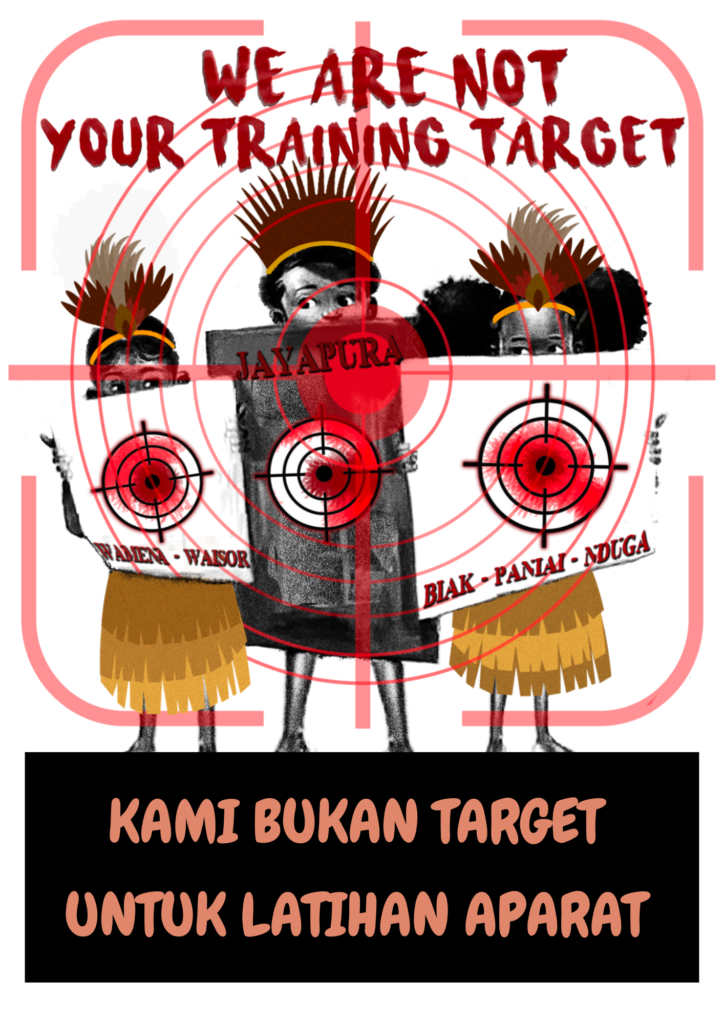
The Land Forces event, Australia’s foremost military trade show, must be completely disrupted and eradicated from existence. It serves as a chilling marketplace for arms deals and a networking hub for the defense industry, wielding a devastating impact on regions burdened by oppressive regimes, such as West Papua. Here, the Indonesian military’s violent grip continues to unleash unspeakable human rights abuses—a dark reality that cannot be ignored.

The Indonesian National Police (POLRI) and National Armed Forces (TNI) stand accused of relentless and egregious violations in West Papua: horrific acts of extrajudicial killings, brutal torture, and arbitrary detentions. Esteemed organizations such as Amnesty International and Human Rights Watch have meticulously documented numerous heart-wrenching instances in which the TNI relentlessly targets innocent civilians, fearless activists, and steadfast journalists from West Papua. The presence of these military forces, bolstered by international arms deals, makes it painfully clear that the trade in weaponry is inextricably linked to the unyielding cycle of violence that continues to plague this vulnerable region.

Australia has a deeply troubling history of supplying military gear to Indonesia—armored vehicles, lethal weaponry, and invasive surveillance technologies. While those transactions are often cloaked in the rhetoric of regional security and defense cooperation, the absence of accountability reveals a harrowing truth: this collusion likely facilitates the brutal operations of the Indonesian military in West Papua. Disturbingly, reports from 2020 surfaced indicating that Australian-made Bushmaster vehicles were used by Indonesian security forces in their oppressive campaign in West Papua. This alarming revelation raises grave concerns about Australia’s complicity in equipping a military force accused of heinous human rights violations.

The Indonesian government’s oppressive strategy to crush independence movements in West Papua is well-documented and utterly unconscionable. The use of military resources supplied by Australia within this context poses an ethical nightmare—one that implicates the Australian government in the ongoing arming of an entity steeped in cruelty. In West Papua, military presence is not merely an instrument of oppression; it is a formidable barrier to the region’s desperate and rightful quest for self-determination. There have been countless documented cases of violence against peaceful demonstrators and crushing limitations on freedom of expression, all of which reflect a brutal reality that cries out for justice.

The Disrupt Land Forces protests are not merely symbolic acts of dissent; they are a passionate call to action, urging an urgent re-evaluation of the catastrophic repercussions of military trade on the most vulnerable, in places like West Papua. The unchecked flow of military equipment only serves to empower those intent on silencing and dominating the indigenous people of West Papua. These protests aim to force this undeniable truth into the spotlight, shattering the fallacy that profit from arms sales can ever be deemed acceptable when it comes at the horrifying expense of human dignity and freedom. By disrupting this heinous trade, activists are fighting for a world where ethical imperatives triumph over economic gain—a world where the lives and rights of people in places like West Papua are fiercely defended and never sacrificed on the altar of the military-industrial complex.

Words by Ronny Kareni & friends.

Written by disrupt wars · Categorized: Uncategorized

Aug 12 2024

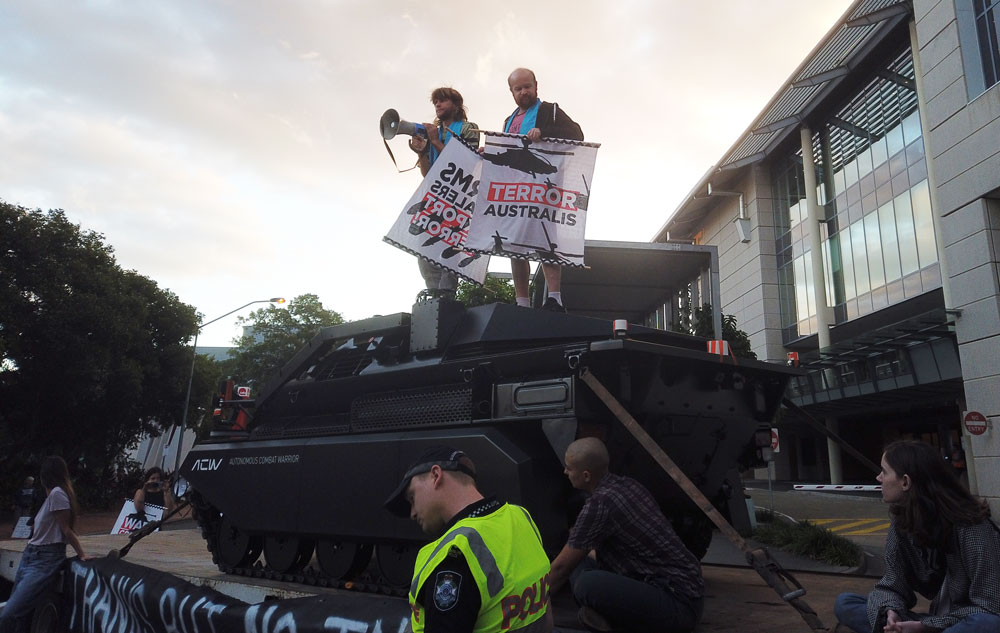
Thanks but no tanks

Greg and Jarrah stop the tanks

Read it here or download and read at your leisure.

Loading Viewer...

Written by disrupt wars · Categorized: Uncategorized

  • Page 1
  • Page 2
  • Go to Next Page »

Footer

Join the mobilisation

  • Email
  • Facebook
  • Instagram
  • Twitter

Donate to Disrupt War

Copyright © 2026 Disrupt Land Forces