• Skip to main content
  • Skip to footer

Disrupt Land Forces

war crimes start in corporate boardrooms

  • Media
    • November 8 Media Statement
    • Community Letter on Land Forces Policing 
    • September 11 Media Statement
  • About Disrupt
    • First Peoples First
    • Our Commitment
    • The Collaboration
    • Why we disrupt
    • Five reasons to Disrupt Land Forces
    • West Papua Calling
    • Copping the bill
    • Disrupt Land Forces in the Media
  • Resources
    • Weapons Dealers in Australia: A Map
    • Deregister AMDA
    • Community Letter
    • Disrupt Posters
      • Disrupt Posters
      • WANTED POSTERS
      • TW: Weapons impacts.
    • Weapons Companies
      • Thales
        • Thales Factsheet
        • The Arms Dealer, The Activist and the Refugee
      • Boeing
      • Rheinmetall
      • EOS
      • Elbit
      • NIOA
      • Lockheed Martin
      • Hanwha
    • Background and research
    • Song & Chants
  • DLF stories
    • 2024 Disrupt Land Forces
      • DLF 24 part one: Organising
      • DLF 24 part two: Mobilising
      • DLF 24 part three: Resisting
      • DLF 24 part four: Enduring
    • 2022: War Criminals need not apply
    • Disrupt Land Forces 22 Gallery
    • 2021: Thanks but no tanks
    • 2021: Disrupt Land Forces was glorious
    • Disrupt Land Forces 21 Gallery

disrupt wars

Aug 08 2024

Disrupt Land Forces 22 Gallery

BREAKING: Conference of world-leading high tech weapons companies baffled by activist’s cunning use of ladder…

We laughed, we cried, we screamed, we sang, we danced and we shared an incredible experience together. Take a look through our gallery to check out some beautiful people creating beautiful disruptions.

DCIM\100MEDIA\DJI_0817.JPG
DCIM\100MEDIA\DJI_0824.JPG
DCIM\100MEDIA\DJI_0153.JPG

Strategic, bold, direct and discursive action to disrupt militarism in Australia and our region.

Written by disrupt wars · Categorized: Uncategorized

Aug 05 2024

WANTED POSTERS

These war profiteers may be found at arms dealer events such as LAND FORCE 24 at the Melbourne Convention Centre. You may spot one in the streets, at a bar or a cafe, making bank off genocide. Approach with caution. Call for help. Arms dealers have no moral compass and may appear lost. Don’t be fooled. They know exactly how much harm their dealings do. Arrest on sight.

Written by disrupt wars · Categorized: Uncategorized

Nov 16 2022

Copping the bill

Queenslanders cop the bill for Land Forces

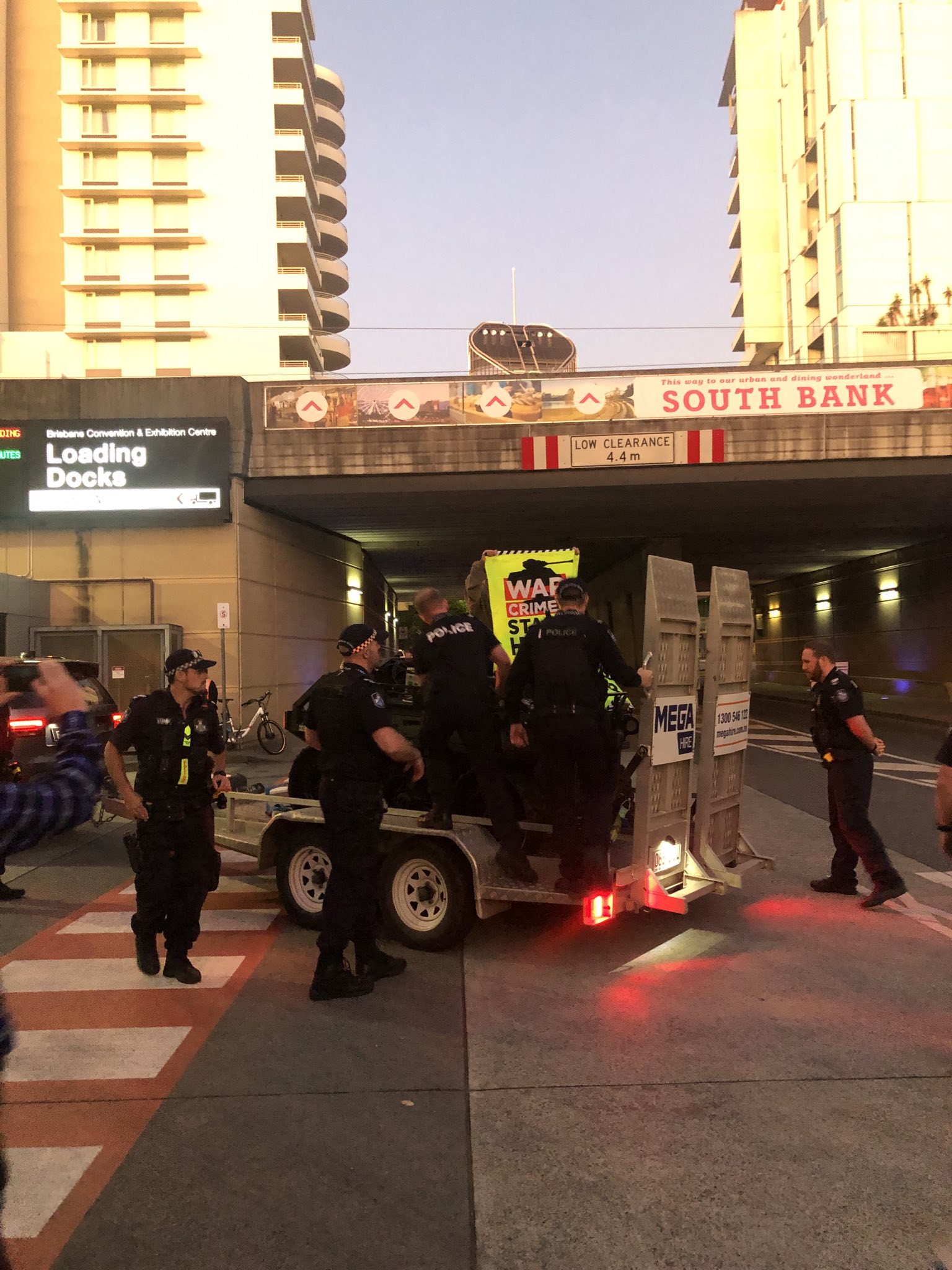
It was a seemingly innocuous Thursday afternoon in South Brisbane. Picnickers relaxed in the parks, commuters rushed around on their different modes of transport, hospitality staff around their kitchens. And military vehicles began loading into the Brisbane Convention Centre. Actually that last bit is maybe not that usual. The vehicles were being readied for the Land Forces Defence Expo, an international weapons sales conference that was staged between October 4-6. Land Forces was held at the Convention Centre due to the generosity of its “host sponsor” the Queensland state government.

As the vehicles began to enter, something else unexpected happened. Two young women jumped on top of an EPE Hunter Wolf small unmanned military vehicle which was being towed into the centre. It would have been a surprise to many, but obviously not everyone. Because instantly, from the South Brisbane police station, eight police officers appeared to surround the vehicle, drag down the women and arrest them.

It was the first, but certainly not last, appearance of the 2022 Land Forces police taskforce. As that first Thursday evening (six days before Land Forces actually began!) went on, more and more police appeared. They drove laps around the Convention Centre, stopping to question anyone loitering nearby. They parked up outside Musgrave Park, stopping and searching every vehicle that exited the park or Jagera Hall. And then, late that night, they appeared in convoys flanking trucks that drove through the suburbs of Brisbane up to the back dock of the Convention Centre. They weren’t there just to keep an eye out either – with lights flashing, sirens blaring and motorbike cops speeding ahead to block intersections, the convoy raced through red lights at about 80km/h.

Most of the large weapons being displayed on the Land Forces shop floor probably made it into the Convention Centre unimpeded that night. But it wasn’t mission completed for the cops. As protesters gathered over the weekend for a program of workshops and entertainment, police were constantly lurking nearby. Cop cars frequently sat parked outside the protesters’ base at Jagera Hall. Most drivers leaving there were “randomly” drug and alcohol tested, their cars inspected for defects. My wife’s car was one of those stopped one night – a traffic cop crawled under the car until he could find a reason to write a ticket, tyres worn on the inside being the justification he was looking for in the end. For those unfamiliar, this is an extremely common tactic of police trying to restrict protest. I have scarcely ever in my life heard of cops inspecting cars for defects in any other context, but it is entirely to be expected at a protest – where police are not supposed to actually stop you from protesting but will look for any other avenue to restrict or arrest you.

By the Tuesday morning, when the Land Forces expo actually began, the police and private security presence had reached its apex. There were beat cops, traffic cops on motorbikes, Tactical Response Group in bullet proof vests, police negotiators in polo shirts.

They weren’t just hanging around the Convention Centre either – about a kilometre away, cops pulled over a car and trailer. They obviously had done their homework/surveillance, because it was indeed headed towards Land Forces with a hot pink model tank ready to block the entrance. They arrested two people who were in the car, and detained and questioned a few onlookers. At times during the conference protesters ventured into the nearby Southbank precinct to try to engage visitors in a bit of candid conversation. To their surprise, they found the entire area awash with police waiting to intervene. One person was arrested for public nuisance in Southbank.

Meanwhile, back at the Convention Centre you could be forgiven for thinking it was not a defence expo but a fence expo. Three temporary fences had been successively erected outside the main entrance – a one metre barrier by the stairs, then two three metre cyclone fences, the second one made opaque by sheets of blue plastic covering the entire face.

Amazingly, an hour or so into the convention and security decided that wasn’t enough. So they erected a new fence and told protesters they had to move to the other side. Local councillor Jonathan Sriranganathan refused – saying that a public footpath does not cease being public footpath just because one erects a temporary fence on a whim. Police disagreed, and our local government representative was arrested for trespassing on government property.

The arrests over the subsequent days were for similarly minor infringements – fake blood (easily washed off) spilled on the walls of the convention centre or a car containing former defence minister/current weapons industry lobbyist Christopher Pyne; an intellectually disabled woman arrested for public nuisance. Protesters attempting to push the line to any extent were quickly met by the many police present.

The next morning I arrived early. There weren’t many protesters there, but police were ready all the same. At one point I was standing alone holding a sign, surrounded by seven cops. Other police were milling about keeping an eye on the rest of our small group, while two security guards patrolled each of the Convention Centre’s many locked doors.

There was a kind of poetic justice to the Convention Centre being made to look like a militarised checkpoint – bringing home to Land Forces delegates the reality of what their products are used for around the world and a small taste of the humiliating reality of that being your day to day experience. But ultimately, security checks may be an inconvenience for those who pass through them, but their real purpose is felt by those they exclude – in this case Queensland citizens who were footing the bill for Land Forces but not privy to seeing what deals get done there.

That day, a small group of protesters kept vigil at the convention centre (of course accompanied by police and security), but the majority of the Disrupt Land Forces crew hit the road for a tour of weapons facilities around the city – including, I should note, a protest at NIOA led by Warlpiri elder Uncle Ned Hargraves against NIOA’s contract supplying guns to police like the one that killed Yuendemu teenager Kumanjayi Walker. A convoy of police cars was dispatched to dutifully follow us to each location, and of course by the end of the day’s trading at the expo they were back to man the exits.

The third day was much the same – a squadron of security guards watching the convention centre from very early in the morning, joined by several dozen police from about 7:30am. This at least provided a ready audience for the morning program of folk singers performing a repertoire of anti-war songs, though they were maybe not the most enthusiastic crowd. Brisbane’s iconic tea pourer Ollie was also stopped and searched, police letting him go when they found his morning tea trolley did indeed only include china cups and jam drops.

As the convention drew to a close, the riot cops finally had something to do – protesters blocked the exits and police came to eventually clear them out. A couple of arrests and one more evening standing guard, and the cops could finally knock off, though extra security remained for the sizeable packdown operation over the next few days.

I spoke to one police officer at the end of Land Forces who confirmed my own analysis – “I think last year they got caught a bit by surprise by protests, so this year they were a lot more planned”. Part of the plan, presumably, was to get as many cops as possible from around the city and pay them overtime to stand around at the Convention Centre or sit in a car outside Jagera Hall. It also involved a team of trained negotiators. From what I have heard, the inside of the centre was heavily patrolled as well, and the fact that there were two distinct uniforms worn by the many security guards suggests a whole new security company was contracted to the Convention Centre just for Land Forces. What else did the security plan include? Surveillance of protesters? Presumably at least to a basic level. What does all that add up to? One insider source said there were 600 police at Land Forces!

I guess when it comes down to it one would say all those police successfully did their job. Protesters were unable to replicate the disruptions to the conference from last year or the media coverage that came with it. But at what cost? Of course we don’t know the specifics, but at a rough estimate I would say a lot. Will we ever know? Last year the local MP Amy McMahon asked in parliament how much the state government had spent on Land Forces. She was fobbed off by Labor, and is likely to be again this year.

How can the state government justify this expenditure? What deals could possibly transpire at Land Forces that would enable recouping this money? And what kind of deals? I’m not sure that our government bribing multinational companies by throwing money at their sales conference is the kind of business we want.

But also, a government is not a business meant to invest money in order to make more. What social good does Land Forces do for the people of Queensland? The hundreds of private companies at Land Forces provide very little immediate benefit for most Australians and a very negative social cost in many places around the world.

One of those costs, of course, is the policing of protest. Many of those weapons sold at Land Forces will go to governments who use them solely to repress their own people – a fact we were reminded of during Land Forces by the presence of West Papuans and Palestinians talking about their occupied homelands. The weapons industry entrenches injustice and corruption around the world by allowing governments to crush dissent. The bottomless purses of military expenditure means the system is always stacked against everyday people who try to challenge the status quo – no matter how worthy their aims are.

I couldn’t help but reflect on this as I stood at the Convention Centre surrounded by armed police watching my every move. While Land Forces promised to show those who went inside the cutting edge of weapons technology, those of us on the outside got front row seats to see what militarisation of society looks like in Queensland in 2022.

– Andy Paine

Written by disrupt wars · Categorized: DLF22

Sep 28 2022

Five reasons to Disrupt Land Forces

Five reasons to Disrupt Land Forces

The Land Forces International Defence Exposition is coming to Naarm. The biggest arms fair in the southern hemisphere, it will take place from September 11th to the 13th of September at Melbourne Convention and Exhibition Centre. Last year it was held in Meanjin, where is was the anti-militarism activists who stole the show – blocking tanks and trucks during the setup, staging cacophonous protests outside the convention, breaching the defences of the defence expo to run inside and jump all over a tank, and in general making the whole thing quite unpleasant and difficult to organise. This year, we are getting ready to do the same again in the hope that this is will be the last time arms dealers do business in our city. Here are five reasons to Disrupt Land Forces:

1. Basic honesty.

Look on the front page of the Land Forces website, and you could be forgiven for not knowing what it’s all about. The word “weapons” is never used once, nor even the common euphemism “arms”. “Defence” features a lot, with some fancy sounding weapon names, and all kinds of indecipherable jargon like “key meeting hub for Australian and international industry, defence, academia and government, as the Australian Army implements the most substantial period of recapitalisation and optimisation since the Second World War.”

Why be so coy? If the Land Forces exhibitors are going to travel from around the country and the world to show off their products, shouldn’t they be proud of what they do? Instead they have to walk a tightrope between privately boasting how efficient and effective their products are at “eliminating targets” while publicly pretending that all they are selling are a bunch of buzzwords.

So it’s up to the protesters to point out what’s really going on inside the Convention Centre – they are selling tools to kill people, or at least threaten them with death. And not just theoretical “targets” either. These are real people, with names and families, who have been killed by the weapons being showcased at Land Forces. That’s why Disrupt Land Forces is making sure to invite people from the affected communities – West Papuans violently occupied by Indonesian forces armed by Thales and Rheinmetall; Palestinians locked in the Gaza Strip surveilled by Elbit Systems, Aboriginal people in the Northern Territory demanding police stop bringing NIOA guns into their communities after too many deaths at the hands of police.

As Land Forces delegates schmooze and booze next week, we need to disrupt it to remind everyone what is really behind those business cards and sales pitches – weapons of death and destruction that rely on ever expanding wars and surveillance to keep their profits rising.

2. To protect our planet.

The military, and those who make its weapons, are some of the world’s worst polluters. The natural environment is always one of the first casualties of any war, and even outside of conflict the military are constantly emitting vast amounts of carbon dioxide as well as plenty of other harmful chemicals. Here’s a stat for you: studies estimate that the military accounts for 6% of global carbon emissions. Yet nations do not even count the carbon cost of their military when it comes to calculating their emissions towards the Paris climate goals.

Australian Defence Force chief Angus Campbell has actually said that climate change is Australia’s greatest security threat, and certainly we have been besieged by natural disasters in recent years to an extent invading forces could only dream of. Unfortunately, when it comes to climate it seems our military is doing more to harm us than protect us.

Some people will justify military expenditure by saying the army is useful for natural disaster relief. But when people say this they ignore some important considerations – firstly that the immense carbon footprint of all the jets, helicopters, tanks and ships is making climate change worse and therefore increasing disasters; and secondly that every dollar and minute spent on the military and the arms trade is money and time that could be spent on what we actually need – renewable energy, energy efficiency measures, global climate strategy, disaster relief planning, climate resilience programs.

But that’s not the entire story either. On the frontiers of environmental destruction, it is the military that are enforcing extraction. In West Papua, Sarawak, or the Amazon, it is the military, using weapons displayed at Land Forces, who come in and move indigenous people off their land to allow forests to be cleared for mining or cash crops.

Like every other corporate buzzword, the companies at Land Forces like to talk about sustainability. But it’s only the protesters who will state the obvious – that to protect our earth we need less weapons sold, not more.

3. To stop corruption

Any study of global corruption requires large sections dedicated to the arms trade. Researchers suggest it is the most corrupt industry on the planet. Tufts University in the US tries to keep track of all the dirty deals, and has concluded that “corruption within the industry is often treated in terms of isolated incidents, when it is, in fact, representative of the business model for the industry“.

That corruption comes in many forms, and doesn’t just affect conflict zones where the weapons are used. In Australia, defence industry corruption is abundant – with weapons manufacturers employing battalions of lobbyists and infiltrating the army, Department of Defence, strategic think tanks, even the War Memorial foundation.

Journalism website Michael West Media has been conducting a study into what it calls the “revolving doors” of personnel between the military, government, and weapons industry. On that website it lists nineteen examples of people who in recent years have moved between roles in these different sectors – no doubt making and repaying countless favours and loyalties along the way.

The government throws around extraordinary amounts of money when it comes to the military, with the transactions often obscured by “national security” or “commercial in confidence” layers of secrecy. In these circumstances there are plenty of opportunities for a few extra million to be added to prices unnoticed. When senators have inquired the many dodgy deals in parliament, their questions are constantly batted away.

Christopher Pyne, who was Defence Minister for quite a few of those deals, literally walked straight out of his ministerial position into the employ of the weapons industry – first working as “executive consultant” at EY Defence, and currently holding positions at no less than ten companies and organisations with links to the weapons trade. It is extraordinary that this could be tolerated – a man who was privy to every sensitive discussion of national military strategy be allowed to suddenly appear on the side of the companies who stand to gain from them commercially. Last year Christopher could be seen shamelessly striding into Land Forces, with the protesters being left with the task of reminding him that he was elected to work for the defence of Australians, not to line up cushy corporate jobs for himself.

Land Forces relies on a certain dehumanisation of others to be able to sell all its products. But when the strategies of the arms trade include corroding our democratic structures for their own private gain, we need to realise that the targets are all Australians.

4. To challenge the arms trade’s claims of “progress”

The weapons industry loves to talk about innovation and development. Even outside of their official propaganda you hear it repeated – how good wars have been for technological invention. The industry gets a lot of mileage out of this. They get government grants for research and development (to ultimately make products they will then sell for more money to the same government!). They enter into agreements with universities – to funnel high achieving students straight into their employment, and to hijack the university’s reputations as knowledge gathering institutions for their own private profits. They even run programs in primary and secondary schools, trying to to entice students from an early age with the promises of playing with all the fanciest toys and being at the cutting edge of technological development.

No doubt many of the displays at Land Forces will possess impressive technological abilities. But to what end? Bigger and better ways of killing people? Often they don’t even manage that – one of the biggest technological advances in warfare in recent decades has been unmanned attack drones, which have been notorious for killing civilians despite claims of efficiency.

When you look more closely, some of the companies at Land Forces have been responsible for some of the worst technological developments in the last century – cluster bombs, land mines, nuclear weapons, concentration camps. To this we can add weaponised drones, and probably lethal autonomous weapons – the next step in technological warfare which many of the companies at Land Forces are working on as you read this.

Not only have these “developments” not really progressed society in any way, they have probably set us back as a species. They have killed, impoverished and traumatised many people who otherwise would have had plenty to contribute to society. They have directed trillions of dollars of public funds away from other causes in which it could have been invested. And they have harmed not only the people on the receiving end, but also those using the weapons – men and women with ample gifts they could offer society who end up grappling with PTSD or engaging in sociopathic behaviours like some of Australia’s most elite soldiers have been shown doing in Afghanistan.

The harms of the weapons industry would almost certainly have been worse if not for the counterweight of the unfunded and unheralded work of the anti-war movement. While all the money and media glory went to the military and their shiny weapons, everyday people were working together across borders to ban cluster bombs, land mines and nuclear weapons; to house the refugees and heal the traumas of war; to expose what really goes on at the frontlines of conflict.

It is this – hard work done for the love of it, in the face of scorn, but for the good of all humanity – that represents the cutting edge of progress; not the killing machines and crooked deals of a self-interested weapons industry.

5. To create a different kind of convention

The Queensland state government is pouring unknown millions of dollars into Land Forces as “host sponsor”, presumably with the justification that there is some kind of public benefit for Queenslanders. This, of course, is extremely dubious for all the reasons already listed.

A very different type of gathering will be taking place outside the convention centre and around the corner at Jagera Hall. A place where people congregate together unfunded and for no material gain. Rather than competing against each other, these people will try to put aside political and social differences to work on a common goal – a goal of peace and sustainability rather than conflict and destruction.

There will be a communal kitchen where meals are shared and voluntarily cooked. A welfare team who will try to make sure everyone is looked after. Friendships will be made, knowledge acquired, and new dimensions discovered within individuals given an opportunity to contribute. Each person is encouraged to bring their unique personal abilities and add them to the whole – whether the skills be creative, communicative, organisational, courage or just willingness to support.

Disrupt Land Forces is just a week-long gathering, but within it we can see the seeds of a very different way of organising our lives and society. Sadly so much of our energy goes to fighting against the vast resources of destructive industries. But every time we get together we learn a few more skills as groups and individuals; we get a bit more inspired; our relationships grow that bit stronger. Gathering together to work towards the world we believe in brings it a little bit closer to existence. There are plenty of good reasons to Disrupt Land Forces on October 1-7. Hopefully we will see you there.

Written by disrupt wars · Categorized: Uncategorized

  • « Go to Previous Page
  • Page 1
  • Page 2

Footer

Join the mobilisation

  • Email
  • Facebook
  • Instagram
  • Twitter

Donate to Disrupt War

Copyright © 2026 Disrupt Land Forces